20 March 2018

A Taste of Honey (Rita Tushingham)

A Taste of Honey with Rita Tushingham
(Amazon UK link)
Years ago we acquired some DVDs which a relative had collected free with weekend newspapers. ‘A Taste of Honey’ came with a Sunday Telegraph, and has sat in our to-be-watched DVD drawer for five years or more. We knew it was black-and-white, which isn’t necessarily appealing, but last night we finally decided to watch it.

The film, made in 1961, is set in a northern coastal town of the UK. It stars Rita Tushingham as Jo, a young girl of perhaps 15 or 16. She lives with her mother Helen (Dora Bryan) but the two have an acrimonious relationship. Helen likes drinking and dancing, and men… Jo is full of anger at life in general, and her mother in particular.

We see them doing a ‘moonlight flit’ from a rented apartment where they have fallen behind on payments, ending up somewhere worse, though presumably without either means to pay or references. It’s impossible to tell time-frames, as the action moves forward in random jerks; Jo is at school when we first meet her, then employed at a shoe shop, looking after herself.

We thought at first that it might be somewhat amusing, but it’s really all rather depressing. Rita Tushingham’s acting debut is impressive, and apparently she won an award for the role, going on to a lengthy career as an actress. Dora Bryan is also a expressive, if caricatured and rather inconsistent. At one point she seems to care for her daughter, at other points she ignores her or treats her badly. She’s shallow and increasingly dislikeable as the film progresses.

Jo herself is rather blatant; she appears quite shy at first, but makes male friends as easily as her mother clearly has done through the years. There are a lot of issues in this film which were probably very shocking back in 1961. Jo first makes friends with a black sailor, and then with a young man who is gay. Promiscuity is rife, along with casual sex, although it all takes place off set. Indeed, I see that the film was initially rated as X, although there’s no real violence, no bedroom scenes, and no bad language. Our edition is rated 15, but I see that the general UK rating is now 12. That seems about right to me, although I can’t imagine it being of interest to anyone below the age of at least fifteen.

I understand that the genre is that of the ‘kitchen sink drama’ which was popular in the 1950s and early 1960s in contrast to the lavish earlier films that were produced. So we see a slice of what life probably was like for poorer, working class folk of the era. But the conversation is quite stilted in places, the action slow and plodding, the background music irritating. Worst of all, there’s no resolution to any of the storylines.

I was startled to read that the play on which the film was based had quite a run both in the West End and Broadway. I should perhaps have guessed that it began as a play, since there are only five named characters in the play, as far as I recall, although there are a lot of children around as extras. I was even more surprised to learn that this film is highly rated and won several awards.

Perhaps it’s a particularly good example of the kitchen sink genre; maybe caricatured and depressed looking characters are to be expected. But neither of us enjoyed it. It’s only 96 minutes long, but I found myself regularly glancing at the clock. It certainly isn’t the pleasant escapism I look for in watching DVDs.

I really wouldn’t recommend ‘A Taste of Honey’, but don’t necessarily take my word for it. It’s clearly very popular in some circles.

Review copyright 2018 Sue's DVD Reviews

13 March 2018

Winter Solstice (Sinéad Cusack)

Winter Solstice DVD with Sinead Cusack
(Amazon UK link)
It’s over eleven years since we watched the made-for-TV film ‘Winter Solstice’, based loosely on a book of the same name written by Rosamunde Pilcher. So it seemed like a good idea to re-watch it last night.

The story opens with Elfrida (Sinéad Cusack) scattering the ashes of her late husband. When I read the book ‘Winter Solstice’, about fourteen years ago, I thought Elfrida was quite elderly. She’s supposed to be sixty-three… and when I was in my early forties that age seemed a long way off. Watching the film last night, it struck me how young and lively she seemed… I would have guessed that she was in her mid-fifties.

Oscar (Jan Niklas) is supposed to be considerably younger than Elfrida, but I’d have put him at around fifty. Not that it mattered. Oscar and Elfrida have a good friendship, and Elfrida becomes very fond of his daughter Francesca. Then disaster strikes… an incident which comes early in the book, and which is dramatic and shocking in the film. I didn't remember Francesca having an older half-brother, the selfish and unpleasant Giles.

Most of the story takes place when several diverse and not entirely compatible people find themselves staying in a remote house in Scotland. There are some unlikely coincidences - two people, connected with the two co- owners of the house, both deciding to stay there at the same time, for instance. More unlikely still is that Sam, a young businessman, happens to arrive at the same time as Carrie, a young woman he sat next to on an aeroplane. I don’t remember if the latter coincidence was in the book; evidently I should re-read it soon.

There are some changed details which didn’t matter too much. Carrie is supposed to be aunt to the teenage Lucy, whose father has remarried in the book. In the film, Carrie is her older half-sister, with a very flaky mother. I don’t remember Lucy being caught up in computer games in the book, but perhaps she was. Nor do I recall anything about a business venture, Sam having to make people redundant, or a whisky distillery. But if those were in the book, I may well have skimmed over them as I prefer the relationship parts of the book.

While the scenery and photography were excellent, in places, I was a tad irritated, as I was the first time I saw the book, that there was so little snow. The book has these unlikely characters snowed up for a few days, not wanting to celebrate Christmas at all. The film has surprisingly balmy weather, where people don’t even need to wrap up particularly warmly, and only a sprinkling of snow after the Christmas Eve midnight communion service.

Overall, I thought it a very enjoyable film. I wasn’t expecting it to be the same as the book this time, so wasn’t disappointed. The characters were well-cast, and I thought the pace about right for a character-driven story of this kind. My husband is happy to watch this kind of film with me, and also enjoyed it although he commented that some of the sound was not quite correct. I hadn’t noticed.

The rating is PG, which I think is probably right. There’s the shocking scene I mentioned earlier, and quite a violent tussle later in the book. There are a couple of ‘morning after’ bedroom scenes, although no explicit nudity or intimacies. There’s not much bad language, although the word ‘God’ is used as an expletive several times, including (rather oddly) at least once by the Vicar.

The story is quite intense in places too, but since it mostly concerns adults and their relationships, the film is unlikely to appeal to anyone below the age of about fifteen.

I would recommend it to anyone who likes this kind of gentle character-driven story, with the proviso that you should not expect it to be closely connected with Rosamunde Pilcher’s novel ‘Winter Solstice’.


Review copyright 2018 Sue's DVD Reviews

27 February 2018

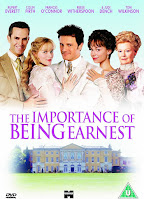
The Importance of Being Earnest (2002)

The Importance of Being Earnest
(Amazon UK link)
There are some stories that form part of national consciousness, it seems to me. I don’t think I have ever read or seen Romeo and Juliet, for instance, yet I know the story well. I don’t recall when I first knew about ‘The Importance of being Earnest’, Oscar Wilde’s classic play set in the late 19th century. But I feel as if I’ve always been aware it was about upper class foibles, deception, and of course a pun on the name ‘Earnest’.

I’m pretty sure I saw a film version years ago, probably the 1952 version, which is - apparently - fairly true to the original. My memory is of most of it taking place indoors, in formal drawing-rooms, but I also recall finding it quite confusing. I read the book on my Kindle a few years ago, and was surprised how much I enjoyed it. 

When my husband suggested watching our DVD of the play last night, I somehow thought it would be the version I had seen before. I don’t remember when we acquired it. Perhaps it was part of a special offer, back in the days when I was trying to buy classic films on DVD to start a collection.

I turned out that we have the 2002 film adaptation of the book, with Dame Judi Dench playing Lady Bracknell, the overbearing matriarch. Colin Firth stars as the young man Jack Worthing who has invented a brother called Ernest. When he goes into town, ‘for pleasure’, as he puts it, he assumes the identity of Ernest. Jack’s friend Algie (Rupert Bracknell) is Lady Bracknell’s nephew, and very keen to meet Jack’s ward, 18-year-old Cecily. Jack, meanwhile, is in love with Lady Bracknell’s daughter Gwendolen (Frances O’Connor).

The film is produced on a larger scale than the earlier versions, with scenes in London clubs and streets, and a lot of the story taking place outside. A young Reese Witherspoon is excellent as the imaginative, beautiful Cecily, her upper class British accent so perfect that we forgot her American nationality. I was also very impressed with Anna Massey as her elderly governess Miss Prism. As with the play, there are only seven main characters, plus a couple of minor ones, although we see plenty of extras in the outdoor scenes.

Most of the text is straight from Oscar Wilde’s play, as far as I can tell, although it’s somewhat cut down. I don’t think anything new was added, but am not familiar enough with the text to say for certain, and have no plans to re-read the play to check. Whether or not it was all Wilde, it was in the right style and despite the somewhat caricatured nature of the people and ridiculous twists of the plot, it was very enjoyable to watch. I appreciated the low key humour and satire, and thought Judi Dench superb in a role which, apparently, she had previously played on stage. Lady Bracknell has some wonderful lines, and she delivers them perfectly.

There are a few extras on the DVD showing the ‘making of’ the film with a few deleted or edited scenes, but all quite short and without adding more than a few glimpses of the cast and crew working together.

The rating is U (PG in the US), probably because there’s no sensuality beyond some kissing and a few innuendoes, no violence other than a couple of mild humorous scenes, and only the mildest of bad language. There’s plenty of drinking and smoking which is appropriate in the historic context of the play, but it’s not the kind of storyline to interest anyone under the age of about thirteen (or older) anyway.

Overall we enjoyed this very much.


Review copyright 2018 Sue's DVD Reviews
20 February 2018

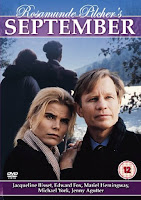
September (Jacqueline Bisset)

September DVD
(Amazon UK link)
For last night’s weekly DVD, my husband decided on ‘September’, the made-for-TV film based on Rosamunde Pilcher’s novel of the same name. We first watched the film back in 2006 and I recalled that it was a reasonably faithful adaptation of the book. My husband did not remember it at all, until he saw the opening and rather morbid shots of a body being removed from a lake…

I’m glad I re-read the book fairly recently, as ‘September’ has quite a large cast of characters, and several interleaved subplots. The main focus of the book is a planned party - a huge one with marquees and Scottish country dancing and a disco. But the storylines involve people who are invited rather than the party-givers themselves.

Vi (Virginia McKenna) is, to my mind, the linchpin of the story. She is in her late seventies, but lively and active in the community. Her son Edmund (Michael York) is quite stubborn. He also works extremely hard and has made a lot of money in his business. He has a daughter, Alexa (Emily Hamilton), from his first marriage, who lives in London. Edmund also has a young son, Henry (Thomas Szekeres), by his second wife Virginia (Mariel Hemingway). Virginia is younger than Edmund, and from the United States, and they have very different ideas about raising children.

Then there are Archie (Edward Fox) and Isobel (Jenny Agutter), impoverished gentry who take in American visitors to supplement their income. Archie was injured in military service and lost a leg; he suffers from nightmares and terrible self-esteem. A recurring theme of the film is the way that Scots tend to button up their emotions and struggle on. There’s a mystery surrounding Archie’s sister Pandora, who ran away twenty years earlier, and this is gradually revealed during the film.

I thought Archie and Isobel very believable with excellent on-screen chemistry. I was less entranced with Edmund and Virginia. Both play their parts well, but it was hard to see any chemistry between them. And while … who played Henry did so extremely well, he isn’t the sensitive, highly intelligent Henry of the novels. I liked Alexa, but was a tad confused that her boyfriend’s name has been changed from Noel to Neil, and didn’t find him particularly realistic.

One of the most underrated but powerful people in the movie is Lottie (Angela Pleasence), sister of Edie (Anna Cropper) who works for Vi. Lottie has some kind of mental condition, but it’s not alzheimer’s; she is not at all forgetful. Instead she is the antithesis of the buttoned-up Scots. She watches everyone and everything, often stealing around gardens after dark, or listening at doors, and then reports on what she considers to be immoral or ‘wicked’ ways. She has a lot of strange mannerisms and Henry is, justifiably, rather scared of her. And it’s Lottie’s ‘chinwags’ with different people that brings some hidden truths to light.

Then there’s Pandora (Jacqueline Bisset), breezing into the movie in time for the party, shocking and/or delighting everyone. She is outspoken and generous, yet also unpredictable and self-centred. The novel is inevitably cut significantly, and in the film we don't meet Pandora until this point. Her back-story is somewhat changed as well, perhaps to keep it simpler and more dramatic.

There’s not a great deal of plot as such, despite so many subplots. This is a film (like the book) of relationships and character development. The ending is bittersweet, and I thought extremely well done. I was a little shocked to realise that the film was nearly three hours long; it was long past my bedtime when it finished, yet I had been gripped, caught up in the lives of the people in the story.

There’s some lovely scenery, though I gather the film was shot in Ireland rather than Scotland. The rating is PG which reflects the lack of any strong language, violence or scenes of intimacy. But the beginning and end scenes are somewhat traumatic. I don’t feel that this film would be appropriate for children under the age of about 12; in addition to the loch-dredging, there are several references to off-stage bedroom scenes, or images showing the morning after, and there’s a fair amount of mild bad language.

Overall I enjoyed this film very much, and would recommend it to anyone who likes Rosamunde Pilcher’s novels, or this kind of poignant character-based drama.


Review copyright 2018 Sue's DVD Reviews
13 February 2018

Harry Potter and the Deathly Hallows part 2 (Daniel Radcliffe)

Harry Potter and the Deathly Hallows part 2
(Amazon UK link)
A week ago we finally watched part 1 of ‘Harry Potter and the Deathly Hallows’. It was very well done, but I felt there was too much fast action filled with special effects, and too little of the storyline. However, having seen it, we decided to watch part 2 last night.

The action is less rapid in this film, and I only had to close my eyes a couple of times. Most of the story takes place in or near Hogwarts, where Harry is certain one of the final horcruxes must be hidden. He has little clue what it might be, what it is, or how he will destroy it.

Moreover, the school is now in the charge of Professor Snape, with new and harsh regimes. Dementors and death-eaters patrol outside, and the students must toe the line or be punished harshly. The students who support Harry are thrilled to see him Harry when he arrives with his friends Ron and Hermione. But he has no plan.

Events move towards the climax in dramatic ways, with a lot of magical violence, as well as some new revelations and discoveries. Other students play their part, some losing their lives as a result. But Harry alone has to face Voldemort in an encounter which has been inevitable since he started to discover his destiny in the first book.

This film was more thoughtful than the first, and I was almost mesmerised for much of it. There are some very moving scenes, and one or two surprises for those who have not read the book. The theme of good vs evil comes through very clearly, but this is no clichéd story. The series was meticulously plotted and written, with all the threads drawing together in this final part of the story.

I remembered much of the ending from the book - a magnificent ending, in my view - but had forgotten the details. I don’t know how true the film was to the novel, but I don’t recall any major omissions. The epilogue at the end gives the audience a chance to relax and see into the future, tying up some loose ends. It felt a tad out of place in the book, and similarly in the movie. Yet I’m glad it was there, providing closure as this incredible series comes to its end.

The acting is excellent, the pace exactly right, in my view. There are even one or two humorous moments, providing momentary relief in the tension of the story. This is a superb film to end the series, and while it doesn’t stand alone, I would recommend it highly to anyone who has seen the others, but has not yet seen this one.

The rating, as with part 1, is 12 (PG-13 in the US). I assume this is due to the magical and indeed physical violence, which is extreme. While the shots of violence are fairly brief and rapid, there are a lot of bodies, and a great deal of destruction and disaster. The point is made that this happens when evil holds sway, but it’s not appropriate for young children. There’s some minor bad language, too, but it’s almost unnoticeable alongside the wholesale destruction and violence.

Reviews of the other Harry Potter films:

Review copyright 2018 Sue's DVD Reviews

06 February 2018

Harry Potter and the Deathly Hallows part 1 (starring Daniel Radcliffe)

Harry Potter and the Deathly Hallows part 1
(Amazon UK link)
Over the past few years we have watched the first six Harry Potter films, interspersed with many others. I only saw the first two at the cinema; they’re quite tense and I don’t like anything at all scary or fast-moving, so I much prefer seeing them at home. We’ve had the final two - the two-part Deathly Hallows - for nearly five years, since I was given them for my birthday in 2013. But until last night had not unwrapped them.

We were going to wait until we had seen all the others… but it’s nearly a year since we watched Harry Potter and the Half-Blood Prince. Then we were going to watch them with our younger son… but he said there was no need. And we kept delaying the moment. But at last, we sat down to watch part 1.

It’s over ten years since I read the book ‘Harry Potter and the Deathly Hallows’. I loved the book, but my memory of the plot is inevitably somewhat vague after over a decade. That’s not a bad thing when watching a film adaptation, as there are bound to be changes which can be annoying if favourite parts of a book are left out. However, I was glad that I had remembered at least the bare bones of the story. I find it difficult to follow the plots of films unless they’re fairly clear, and this one, intended for a teenage audience, is fast-paced and complex.

The basic story is that the evil ‘dark lord’ Voldemort is back, and the only way to defeat him is by finding all the horcruxes - pieces of his soul that have been hidden away. They were somewhat explained in the previous book, but I’m not sure it matters exactly. So, instead of returning to Hogwarts, Harry and his two close friends Ron and Hermione set out on their own, with little idea where they’re heading, to attempt to find and destroy horcruxes. Along the way they learn about ‘deathly hallows’, but those will probably be explored in greater depth in the second film, which we hope to watch next week.

The first film alternated scenes of the three on their own with fast-paced battles with enemies of various shapes and sizes. When alone, we see them discussing what to do, arguing about how to do it best, and recovering from battles. There’s quite a powerful scene where Ron hallucinates, convinced Hermione likes Harry better than she likes him. And there’s a very moving, poignant scene near the end.

However, there are also a lot of rapid-action scenes, not gunfights but the equivalent with wizarding wands. I am unable to watch this kind of thing; fast action on screen makes me dizzy, and I never have the faintest idea what’s going on. So I shut my eyes, and listen for any words. In the brief seconds I saw, there were dramatic special effects and high drama - but I can’t comment on any more, as it all happened too rapidly. I don’t think I missed anything much; it was always fairly clear what happened from the discussions afterwards.

This really isn’t a film that stands alone, as so much has gone before. Nor is it one I’d necessarily want to see again, although I am now quite keen to re-read the book. But I’m glad we’ve seen it at last. The book was absorbing and made a magnificent ending to the series. There were battles, but on paper they’re so much easier to deal with. The book was filled with Christian symbolism in a way that didn’t really come across in the film, but perhaps that’s not surprising.

The actors playing three main characters have grown with their roles, and I felt were as believable in this, at seventeen, as they were in the first book, aged just eleven.

All in all, I would recommend this, although the 12 rating is worth noting. There’s nothing too ‘adult’ - a little kissing and cuddling, and one implied sexual scene, but no total overt nudity and few innuendoes. There is little bad language, but nothing major. However there's a great deal of magical violence, evident even with my eyes closed, and also some sad losses which could upset a sensitive child.

Reviews of the other Harry Potter films:

Review copyright 2018 Sue's DVD Reviews

30 January 2018

The Terminal (Tom Hanks)

The Terminal with Tom Hanks
(Amazon UK link)
In the past few years, we have managed to watch a DVD about once or twice a month at most. Since we are often given new ones for birthdays and Christmas, our drawer of to-be-watched films has stayed fairly well replenished. However this year we have allocated Monday evenings, whenever possible, to watch a DVD together. So as our new supply was beginning to run low, I found the ones we watched and liked at least ten years ago, deciding I could deal with seeing them again. Last night my husband’s selection was ‘The Terminal’.

We first saw this film on Christmas Day 2006. The day is seared in my mind as a rather depressing one. Our older son had left home and was working on a ship the other side of the world. The friends with whom we had shared Christmas for the previous few years had gone back to live in the United States. Other friends, whom we had invited for lunch, were unavailable. So just three of us sat down to a traditional Christmas meal, feeling far from festive. After lunch we decided to watch this film, which our older son had recommended highly.

Eleven years later, all we could remember of ‘The Terminal’ was that Tom Hanks spent a long time living at an airport, due to political circumstances. We recalled liking the film, and one or two cameo moments. We also remembered having watched the ‘extras’, so we know that the airport terminal, in which most of the film takes place, was custom-designed and built in an old hangar, specifically for the filming.

The story opens with a general impression of an airport in New York - customs, passport control, and so on. Then we meet Viktor (Tom Hanks), a man from a small Eastern European country which apparently started a civil war while he was in the air. His passport had become invalid, as the US no longer recognised his country. So he could neither go out of the airport into New York, nor return to his home country. It doesn’t help that he has almost no English, relying on a phrase book to attempt to communicate. So he doesn’t understand what’s going on until he sees some news reports of violence and recognises his country…

Steven Spielberg directed this, and it’s a wonderful film: character-based, almost entirely, rather than having much plot as such. There’s a lot of low-key humour as Viktor teaches himself English, figures out ways to earn money so that he can eat, and makes himself a place to sleep in the airport. He is watched on security cameras by the airport customs staff, particularly the head (Stanley Tucci) who has no idea how to handle him…

Tom Hanks is excellent in this role, as a confused but likeable man who makes the most of his circumstances at every point. He is treated with suspicion at first by airport staff, but gradually breaks down their barriers. There’s also a low-key and bittersweet love interest featuring an air hostess (Catherine Zeta-Jones) who knows that she’s bad news, yet likes him despite herself.

We were mesmerised for an hour and a half. We had completely forgotten how it ended, and why Viktor was so keen to go to New York. We had not remembered any of the other characters, either, nor any of the interactions that work so well. We hadn’t remembered the mild slapstick humour that happens a few times on a slippery floor; it made us wince somewhat, but was so well choreographed that we smiled at times too.

I would recommend this to anyone who likes character-driven dramas with low-key humour and a feel-good ending. The rating is 12A (PG-13 in the US) and I think that’s about right. There’s some bad language, though nothing too ‘strong’, and some innuendoes, though nothing explicit. Violence on screen could be disturbing, however, as could some shouting and threatening that happens in an incident towards the end. I very much doubt if anyone under the age of about fourteen would find it of interest anyway as there’s not much action or story, and all the characters are adults.

The extras are well worth watching too, in my opinion, particularly those about the building of the set.


Review copyright 2018 Sue's DVD Reviews